Hospitality’s VAT fight has reached Parliament. Now the cut must work for the people running the venues.
The hospitality VAT campaign deserves serious attention. Michael Erridge examines competing proposals, fiscal evidence and what would reach the people running the venues.

I have a professional and personal stake in this argument. Through MDE Pub Consultants, I advise people whose livelihoods depend on making a pub work. I want those clients to have businesses worth running, with enough left to reward their work and invest in what comes next.
That is why I take the hospitality VAT campaign seriously. A publican cannot pay the electricity bill with a sympathetic speech. Nor can a promising operator build a future on a business plan that only works if they stop paying themselves properly.
The question deserves more than another round of politicians saying how much they like their local.
Thursday’s Westminster Hall debate brought the argument back into focus. Chris Webb secured it; Tonia Antoniazzi opened it. Treasury minister James Murray acknowledged that a cut would help affected businesses, but set out a substantial fiscal objection. HMRC puts a broad reduction to 10% on accommodation and food and beverage services at around £11 billion a year. Its estimates for 15% and 12.5% are around £5 billion and £8 billion respectively. Murray said the calculations already include expected demand and supply responses.
There was no new permanent cut. There is, however, a policy argument the industry should sharpen rather than abandon.
First, decide which VAT cut we are discussing
The Tom Kerridge-led VAT’s the Problem campaign wants a 10% hospitality rate. Hospitality Voices, organised by Andy Lennox and The Wonky Table, proposes a targeted 13% rate for smaller businesses. Separately, the Northern Ireland Affairs Committee has called for a four-year 10% pilot on food, excluding alcohol, and accommodation in Northern Ireland.
Those are materially different propositions. They reach different businesses, cover different sales and carry different costs.
Dr Siamand Hesami of Bournemouth University has now supplied MDE Insights with his September 2026 note, Targeted VAT Relief for Hospitality: The Fiscal Cost of a 13% Rate for SMEs. It puts the targeted proposal’s annual net cost at £2.6 billion to £3.8 billion, with an illustrative central estimate of around £3.2 billion. That is an independent model, not an official Treasury costing.
The note covers food and drink consumed on the premises, including alcohol, and currently standard-rated takeaway collections. It excludes delivery and accommodation. Eligibility would use the Companies Act classification of non-large businesses, assessed on a group basis, rather than simply counting individual venues. That makes the treatment of independent tenants and franchisees particularly important.
The key assumption is how much eligible trade those businesses supply. The note tests 50%, 55% and 60% of a £110 billion VAT-exclusive base, with 55% as its central case. At that share, the annual net cost is £2.89 billion on a mechanical basis and £3.50 billion using a more cautious gross-cost allowance. The £3.2 billion headline is approximately the midpoint of those two results. The wider range describes scenarios, not a statistical confidence interval.
The model also scales assumed tax recovery in proportion to the eligible share. Its 28–32% self-funding estimate therefore follows from that approach; it is not a separately measured result for smaller businesses. In his response, Hesami identifies jobs preserved, and the associated PAYE and National Insurance, as the largest recovery channel. He says the costing assumes 55% price pass-through, a demand elasticity of −0.6 and a volume response of about 2%. Those are modelling assumptions, not guaranteed outcomes.
“The targeted estimate is an independent, illustrative costing, not a formal fiscal scoring, and should be read that way,” Hesami told MDE Insights. “That is why the case rests on business survival, not cheaper meals.” He says HMRC’s firm-level data are needed to settle the eligible share and welcomes an official costing.
For me, that moves the discussion forward. We now have the workings rather than just a campaign number. The next test is whether the employment-retention assumptions stand up, and whether the eligibility rules reach genuinely independent operators without creating a penalty for growth. I have asked Hesami how the jobs-preserved assumption was calculated and how independent pub tenants would qualify. Those questions remain open.
This annual targeted estimate must not be confused with the earlier, publicly available March paper, which models a broader 13% food-and-drink reduction. It produces a central annual net cost of £6.36 billion; its approximately £3.2 billion figure covers six months. That paper includes alcoholic drinks and collection orders, excludes delivery, and explicitly says it is not a formal fiscal costing.
These figures cannot simply be put in a column and treated as competing answers to the same question. Before anyone declares the Treasury wrong, or the campaign unaffordable, both sides need to cost the same policy over the same period.
What would actually reach the business?
There is a simple calculation worth doing before the debate disappears into billions.
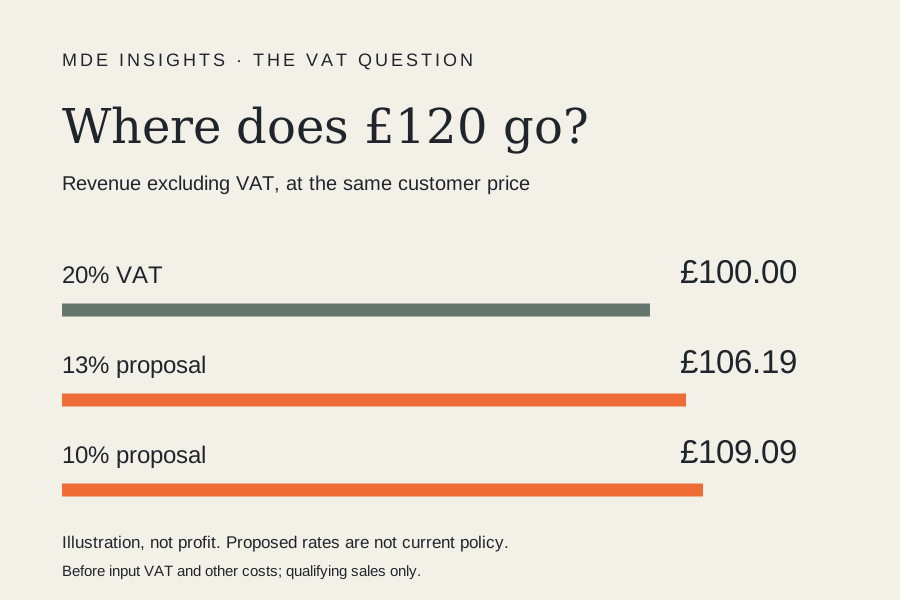
Take £120 of qualifying sales, including VAT. At 20%, the business has £100 before its other costs. At 10%, with the customer paying the same £120, that becomes £109.09. At 13%, it becomes £106.19.
That is additional revenue after output VAT, not an automatic profit or a forecast of the final VAT bill. Input tax, eligibility, demand, pricing and operating costs still matter. But for a business operating on a narrow margin, the difference can be commercially substantial.
Alternatively, hold the business’s net price at £100 and a 10% rate brings the customer’s bill down to £110. The customer gains; the business does not retain the same saving.
The same pound cannot simultaneously fund a full price reduction, an extra employee, a refurbishment and a better return for the operator. A campaign becomes more convincing when it says honestly how the benefit might be divided.
My starting point would be viability. There is nothing improper about an operator using tax relief to rebuild working capital, replace failing equipment or preserve a job. If the stated objective is to keep otherwise viable businesses trading, retained margin is part of the mechanism, not evidence that the policy has failed.
But that also means we should not sell every proposal to the public as a cheaper-pint scheme.
A pub is not a single category on a Treasury spreadsheet
The treatment of alcohol is particularly important.
The pandemic hospitality relief covered qualifying food and non-alcoholic drinks, alongside accommodation and attractions. It did not provide the same reduction for alcoholic drinks. A food-led pub and a wet-led local therefore had very different exposure to that relief.
Any new scheme needs to be equally clear. An attractive headline rate is of limited use to a community pub if most of its sales sit outside the qualifying categories. Conversely, including alcohol changes the cost, the distribution of support and the public-policy debate.
That is one reason I would resist describing “hospitality” as though every venue has the same profit and loss account. A small hotel, a high-volume coffee shop, a tenant’s wet-led pub and a restaurant with a large kitchen team face different economics. The question is which pressure the policy is meant to relieve, and whether its design actually reaches it.
Targeting smaller businesses has an understandable appeal. It also requires an eligibility rule that survives contact with real businesses. What happens to franchises, connected companies, tenants operating within a large pub estate, and an independent group opening its next site?
A threshold that turns expansion into an abrupt tax penalty would be a poor way to encourage investment. Those are questions for the design stage, before operators discover the answers at their tills.
Follow the benefit beyond the VAT return
My pub consultancy work also makes me interested in what happens after the initial improvement.
For a tenant, a business has to work across its whole agreement: rent, purchasing obligations, repairs, staffing, debt and the return left for the person taking the risk. Looking at one tax line in isolation misses that.
If a VAT reduction improves sustainable earnings, how will that improvement be treated at the next rent negotiation? What assumptions will be made about the operator’s future margin? How much room will remain for reinvestment?
I am not suggesting a tax cut automatically changes anyone’s contractual rent. It does not. Lease terms, review dates and the basis of assessment matter. Nor would every landlord respond in the same way. My point is that the long-term distribution of the benefit deserves scrutiny, rather than being assumed.
Business rates are a separate issue, but another reason to follow the numbers carefully. The Valuation Office’s guidance says pub assessments normally use fair maintainable trade excluding VAT, with factors including operating costs and profitability. That does not mean a lower VAT rate produces an immediate matching rates increase. It does mean the wider valuation system belongs in a serious discussion of lasting relief.
A policy intended to strengthen operators should be evaluated at operator level, after the other claims on the business, not only at the point where the tax saving first appears.
The strongest case does not need a miracle
Evidence from elsewhere is a useful check on easy promises.
A peer-reviewed study by Youssef Benzarti and Dorian Carloni of France’s 2009 restaurant VAT reduction found that owners captured more than 55% of the benefit, consumers benefited least, and employment effects were limited. That is evidence from another country and period, not a forecast for British pubs today. It is still a good reason not to assume a large cut will automatically translate into equally large employment or consumer gains.
The pandemic is also an imperfect experiment. Emergency restrictions, reopening, changes in travel and other support were happening alongside the VAT reduction. A business doing better during relief is not, by itself, proof of how much the tax change caused.
I would rather see the industry make a defensible case for preserving viable businesses than stake its credibility on a promise that the Exchequer will recover every pound.
There are returns worth measuring beyond immediate VAT receipts: continued employment, investment, survival and activity retained in places with fewer alternative employers. Those outcomes still need evidence. They should be compared with what the same public money could achieve through other measures, rather than being treated as free benefits.
What would make this a serious next step?
Publish the complete proposals and the assumptions behind them. Show precisely which supplies and businesses qualify, how much of the reduction is expected to reach prices, and what employment effects are being assumed. Give smaller operators a way to contribute real evidence without asking them to disclose commercially sensitive accounts in public.
Then assess the same designs on a consistent basis. If a pilot is pursued, set the measures of success before it starts: survival, paid employment, investment, customer prices and the net public cost. Where possible, compare outcomes with genuinely comparable businesses outside the measure. Avoid declaring victory from a rise in sales that would have happened anyway.
Duration matters too. An operator considering a substantial investment needs to know how long the rules will last. A brief tax holiday might help cash flow, but cannot sensibly be treated as permanent income in a long-term business plan. There should be a clear account of what happens when relief ends.
I want this campaign to succeed in securing a better operating environment. I also want it to withstand the awkward questions, because those are the questions that determine whether a good headline becomes useful policy.
The people running the venues deserve more than a sympathetic photograph outside the pub. They deserve a proposal whose benefit can still be found in the business after the debate has moved on.
Updated 13 November 2026 with Dr Hesami’s response and the assumptions in his supplied September costing note.
Add your experience
Are you an operator, tenant, landlord, supplier, employee, economist or policymaker with evidence to contribute? I would particularly welcome views on what a lower rate would change in practice, who should qualify, and how the benefit can support the people running the business. Email michael@mdeinsights.com. Please flag anything that should be treated as background rather than quoted, and do not send confidential client or employee information.
Sources
- Dr Siamand Hesami, September 2026 targeted costing note and comment supplied to MDE Insights on 13 November 2026.
- House of Commons, hospitality VAT debate, 12 November 2026.
- VAT’s the Problem: campaign proposal.
- Hospitality Voices: targeted proposal and published estimate; campaign background.
- Dr Siamand Hesami: March 2026 food-and-drink VAT analysis. This is a different, broader model from the currently described targeted proposal.
- HMRC: scope and dates of the pandemic hospitality VAT relief.
- Valuation Office: how pubs are valued for business rates.
- Benzarti and Carloni, American Economic Journal: Economic Policy, 2019.
Analysis and opinion. The financial illustration assumes unchanged qualifying sales and prices unless stated. It is not business-specific tax or valuation advice.