Hospitality sales are growing through new openings. Existing venues are standing still
October managed-group sales were flat on a like-for-like basis but rose 3.7% overall. What the difference means for expansion and Christmas planning.

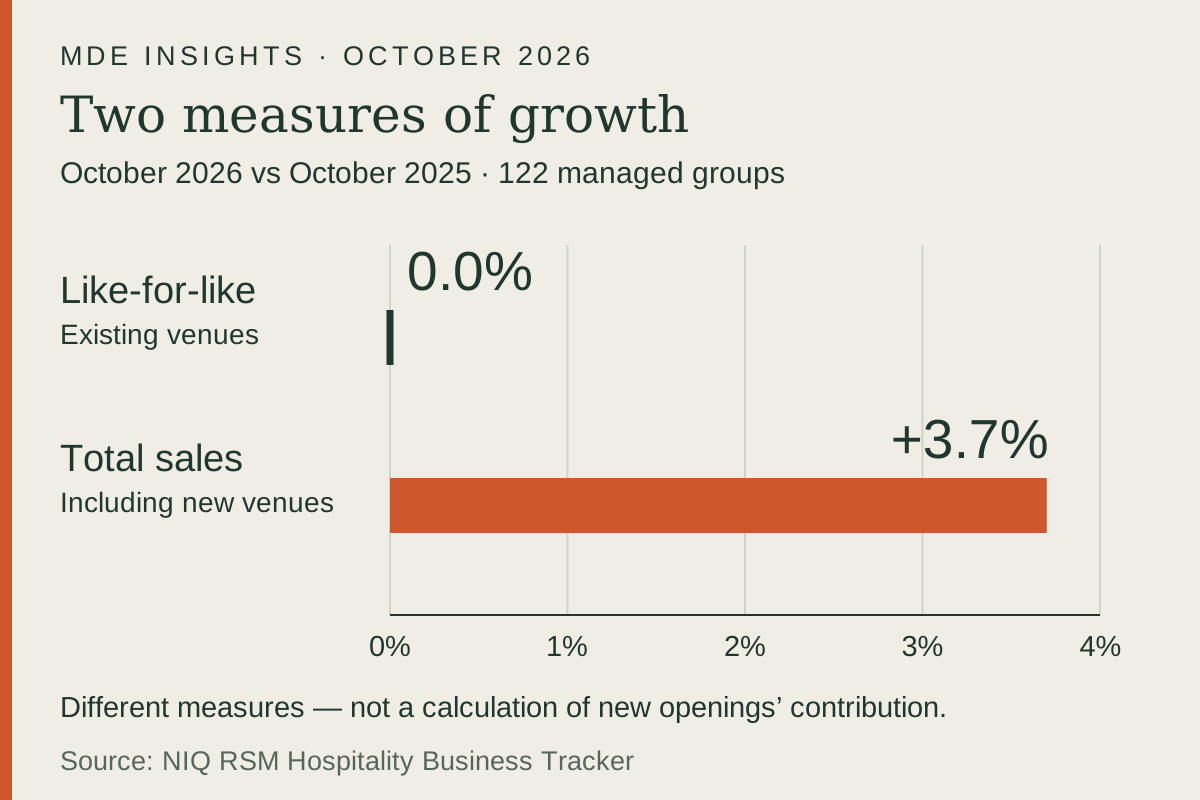
There is an important difference between a business taking more money because its existing venues are trading better and taking more money because it has opened more venues. Both can be legitimate routes to growth. Only one tells us that the established estate is moving forward.
This morning’s hospitality sales figures bring that distinction into focus, just as operators begin the run towards Christmas.
Two measures, two different pictures
The NIQ RSM Hospitality Business Tracker reports that managed groups’ October like-for-like sales were unchanged from October 2025, following 2.7% growth in September. Total sales, including venues opened in the preceding year, increased 3.7%.
The survey draws directly on 122 managed groups. Pubs recorded 0.4% like-for-like growth and restaurants 0.8%, while bars fell 3.1% and on-the-go businesses 7.9%. Sales within the M25 rose 0.7%; outside it they fell 0.3%. These are results for participating managed groups, not a census of every hospitality business. NIQ’s October tracker.
An opening is an investment, not just another sale
For an expanding group, the total-sales figure matters. A new location can reach customers the business could not previously serve and give a good operating model more room to grow. There is nothing inherently wrong with expansion supplying the increase in revenue.
But those additional sales come with another question: what capital and ongoing costs were needed to generate them?
A new site requires investment and working capital. It also adds operating obligations. The commercial test is therefore not simply whether the group is larger, but whether the new operation can produce an acceptable return after the cost of establishing and running it. A healthy opening programme and a struggling established estate can exist in the same business, just as a temporary slowdown can coexist with good long-term investments.
The tracker does not tell us which description fits any individual participant. It does, however, explain why a total-sales headline alone is an inadequate measure of recovery.
Flat revenue does not tell us how many people came through the door
The other temptation is to read unchanged like-for-like sales as unchanged customer demand. Sales value cannot establish that either. It combines the number of transactions, what customers buy and the prices they pay.
For an operator assessing October, separating those components is more useful than treating the industry average as a verdict. Did fewer customers visit but spend more? Did a promotion bring people in at a lower spend? Did a shift between food and drink change the contribution retained from a similar till total?
Those questions require the business’s own figures. Nor should today’s consumer-price release be mechanically subtracted from this tracker to produce a supposedly precise change in hospitality volumes. The two measures cover different baskets and businesses. They can inform the same discussion without being interchangeable datasets.
Christmas needs a contribution plan, not just a bookings target
The immediate response should not be to discount indiscriminately in pursuit of a stronger headline. The useful question is which bookings and trading occasions will leave enough contribution once the extra costs of serving them are paid.
A full Friday evening and a quiet Tuesday create different decisions. Filling spare capacity may justify a carefully costed offer; discounting a session that would otherwise sell at full price may simply give margin away. Deposits, cancellation exposure, staffing and the mix of bookings also belong in that calculation.
For established venues, the next few weeks are a chance to turn demand into cash and sustainable earnings. For expanding groups, they are also a test of whether additional capacity is earning its place. Those are related commercial challenges, but they should not disappear into a single growth percentage.
Sources
Share this article
Keep the conversation going.
Have a view that adds to this story? Write to Michael.
Join the daily brief