Hospitality price rises are slowing. That leaves a harder question about margins
Restaurant and hotel inflation slowed as UK inflation rose. Why operators need to distinguish selling prices from costs, demand and sustainable margins.

For a hospitality operator, a slowdown in the prices customers pay can be welcome if it brings people through the door. It becomes rather less comfortable if the cost of serving them is still rising faster than the amount the business can charge.
That is the question worth asking of this morning’s inflation figures. The answer cannot be read directly from a national price index, but the distinction matters when setting menus, room rates and next year’s budgets.
What the figures actually show
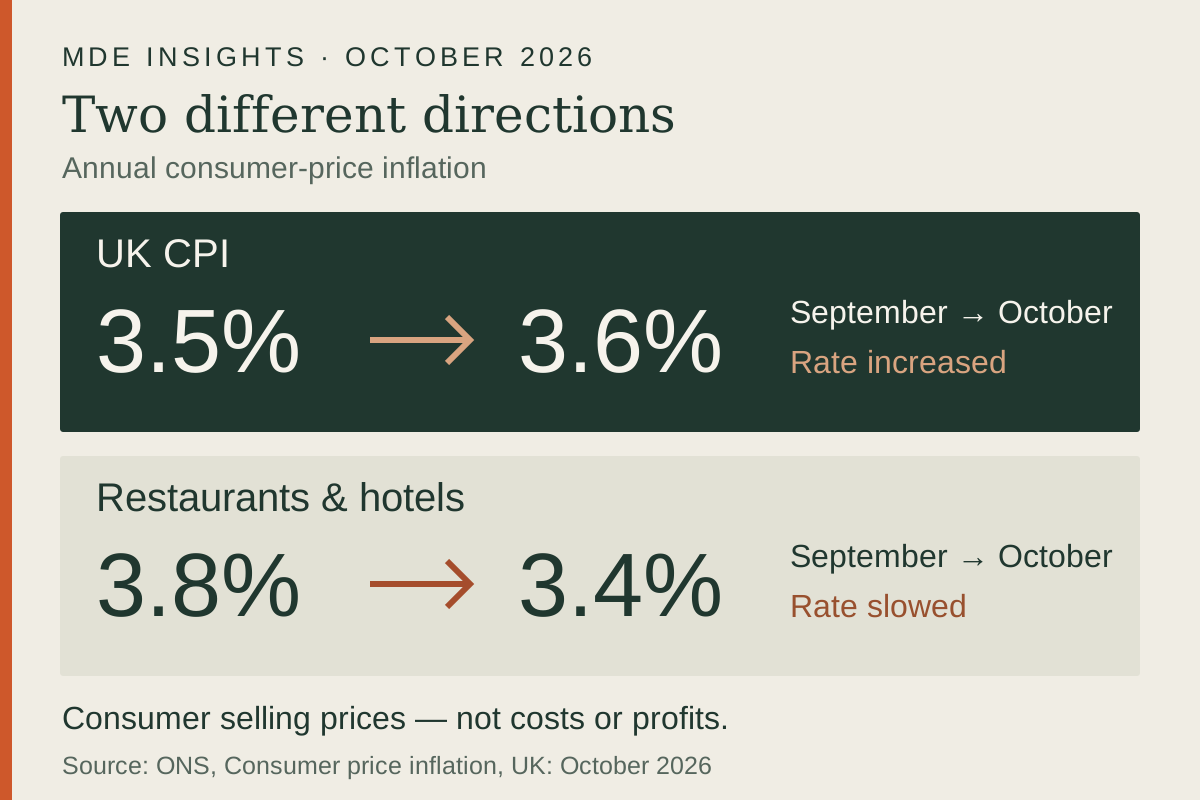
The ONS reports that UK consumer price inflation rose to 3.6% in October, from 3.5% in September. Motor fuels were the largest upward driver. Restaurants and hotels provided the largest offsetting downward contribution: the division’s annual inflation rate slowed from 3.8% to 3.4%.
The division’s prices fell 0.4% during the month. That does not mean restaurant menus generally became cheaper. Restaurant and cafe prices rose 0.3%, compared with 0.6% in October last year. Hotel prices fell 3.8%, against a 3.4% fall a year earlier. The ONS attributes most of the downward contribution to restaurants and cafes, with a smaller contribution from hotels.
These are consumer selling prices, rather than a measure of hospitality businesses’ costs or profits. The combined category also conceals different movements in eating out and accommodation. ONS October inflation bulletin.
The gap operators need to understand
There are several possible explanations for slower price increases. Operators may have found savings, chosen to protect customer value, faced stronger competition or reached the limits of what guests will accept. This release does not establish which explanation applies, or how widely. It would be wrong to treat it as proof that the sector has either recovered or surrendered its margins.
What it does justify is a closer look at the relationship between selling prices, demand and the cost of delivering the experience.
A business can take more money while serving fewer customers. Equally, a successful promotion can increase covers without generating enough additional contribution to cover the extra staffing and other costs. Neither the till total nor a headline inflation rate settles the question.
For a restaurant or pub, useful comparisons include covers, average spend, contribution by menu item and payroll relative to the hours actually traded. For a hotel, occupancy and achieved room rate need to be considered alongside distribution costs and the cost of servicing each occupied room. A higher occupancy figure is not automatically a better commercial result if it was bought through discounts and expensive distribution.
Those measures should be compared with the same trading periods, rather than allowing a national annual average to become a substitute for the business’s own evidence.
Pricing needs more than an inflation assumption
The practical risk in budgeting is to assume that another uniform price increase will recover every additional cost. A guest makes a choice about the whole bill and the value of the visit, not whether each individual increase can be justified in an operator’s spreadsheet.
That need not mean holding every price still. It may mean concentrating on the items and occasions where the business offers something customers genuinely value, while reconsidering low-contribution activity that consumes disproportionate labour or capacity. Any change should then be tested against what customers actually do.
The October figures provide a useful warning against reading a consumer-price story as a profit story. The commercially important question is whether a business can retain enough from each visit or stay to pay for the service customers expect and leave a sustainable return. That requires a view of the whole operation, not simply the percentage added to the next menu.
Sources
Share this article
Keep the conversation going.
Have a view that adds to this story? Write to Michael.
Join the daily brief